Tampilkan postingan dengan label Normatif. Tampilkan semua postingan

Jumat, 16 November 2012

25 Works of Art of Soap


Media berkarya tak pernah diMedia work was never the limit and free expression, the following are examples of works of art with amazing soap med ia


ENGINEERING AND MATERIALS work of applied art

Techniques and Materials Artwork Kriya:

There are several techniques of making craft objects that are tailored to the material. Tools and methods used include cast or cast, sculpture, batik, weaving, weaving, and form.
1. Techniques cast (print cast)When the bronze culture started to go to Indonesia, it became known processing techniques bronze. There are several craft of bronze objects such as gendering bronze axes, vessels, and jewelry.Printing techniques at that time there were two kinds:
• Pour Recurring Engineering (bivalves)
Bivalve technique called repeatedly pouring technique for keeping prints made using twoof stone and can be used repeatedly as needed (bi meaning two pieces danva lve mean). This technique is used to print objects that are simple both in form and decoration.
• Techniques Pour Disposable (A Cire Perdue)
Cire Perdue created a technique for making bronze objects and decorative shapes are more complicated, such as statues and bronze sculptures. This technique begins by making a model out of clay, then coated with wax, and then closed again with clay, then baked to remove the wax and become involved in the cavity, so that the bronze can be poured into it. After a cold mold clay can be broken down in order to obtain the desired bronze objects.Besides casting techniques there are also techniques to forge the ingredients come from bronze, copper, brass, silver, and gold. Such materials can be made into objects of art handicraft, like a dagger, plates, teapots and candlesticks. Currently there are many centers of cast metal handicrafts like silver. Famous landmarks that include silver in Kota Gede Yogyakarta and brass handicrafts located in Heilbron and Mojokerto.
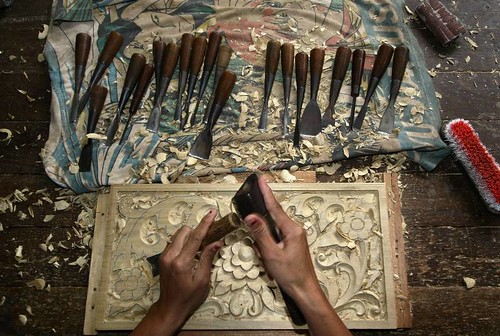
2. Carving Techniques
Alam Nusantara with rich tropical forests into timber that can be used as a base for wood carving. The carvings are scraping activity, sculpt, and incise patterns carved on the surface of objects.In Indonesia, the work of carving stone has been known since a young age. In those days, a lot of equipment made of stone such as home furnishings and objects of pottery or wood. The objects were carved geometric motifs, such tumpal, circles, lines, swastika, zig zag, and triangles. Generally engraving than as decoration also symbolic and religious meaning.Views of its kind, there are several types of carvings include carved translucent (Krawangan), low carving, carving height (raised), and the carvings intact. Carving artwork has a variety of functions including:Decorative function, the carvings are made purely as a decoration and has no particular meaning.Magical function, which is carved containing certain symbols and acts as a magical object associated with beliefs and spiritual.Symbolic function, which in addition to the traditional carving as decoration also serves to symbolize certain things related to the spiritual.Construction function, which in addition to the ornate carvings that also serves as a support building. Economic function, ie engraving which serves to increase the selling value of an object.
3. Batik technique
Batik long been known in the archipelago. However, its appearance is not known with certainty. Batik is an art form that generally form the image on the cloth. The manufacturing process is to add a layer of night and then processed in a certain way or through several stages of staining and the removal rod lo tahapng night.
Tools and Materials
Tools and materials used for batik is generally as follows:Plain fabric, a material that would be motive (picture). The fabric is usually a cloth, Primissima, primed, blaco, and a T-shirt.Tonight, as the material to make the motif as well as a barrier to the entry of the color fabric fibers (threads).Dye, to dye the fabric diasol naptol and salt.Canting and brush to carve the wax on fabricBrush for nemboki the closing night at the width of the fabric surface.In keeping with the times, currently known some batik techniques are as follows:
Tie-dyed batik, batik is without the use of night sebagaia barrier material, but using ropes to prevent the entry of color into the fabric fibers. This process is called batik with batik jumputan.
Batik batik is made by way of giving the night by using canting the motif that has been drawn on the cloth
Batik, batik is made using a stamp (stamp which is generally made of copper) as a tool to create a pattern so that the cloth does not have to be drawn first.
Batik painting, batik is made by way of painting. In this technique the artist free to use the tool to get certain effects.
Modern batik, batik is a way of making free, not bound by the rules of the existing techniques. This includes the selection of motifs and colors, therefore the end result is no motive, shape, composition, and color are the same in every product.
Batik printing, is a motive such as batik fabrics. The process of making batik is not using the batik technique, but the technique of screen printing (screen printing). Type of fabric is widely used for school uniform fabric.
4. Techniques Anyam
Objects of daily living needs, such as baskets, mats, hats and others made with woven techniques. The raw materials used to make objects woven from a variety of plants that take fiber, such as bamboo, palm, cane, rushes, pandan and others.
5. Weaving Techniques
Weaving technique is basically almost the same as the weaving technique, the difference is only on the tools used. For webbing we just do it by hand (manual) and almost without using tools, while the weaving craft we use a tool called lungsi and feed.
6. Shaping techniques
Penegertian forming technique here is to make the works of art with clay media, commonly called a pottery, pottery or ceramics. Ceramic is the work of clay through the combustion process to produce new goods and much different from the raw materials.
A technique commonly used in the manufacture of ceramics including:
a. Coil technique (helical coiled)
b. Mechanical face stone / massage finger
c. Techniques slab (slab)
How the formation of a direct hand as coil, slab or finger massage is a traditional ceramic forming techniques which are free to create the desired shapes. The shape is not always symmetrical. This technique is often used by ceramic artists or the fans.
d. Techniques Play
Shaping techniques with a rotary tool can generate a lot of symmetrical shapes (spherical, cylindrical) and varied. How the formation of the roll technique is often used by the craftsmen in centers Sentara ceramics. Traditional potters typically use a rotary tool (hand wheel) or a foot rotary tool (kick wheel). The artisans work on a rotary tool and produce the same forms as bowl, jar etc..
e. Technique Print
Shaping techniques with print can produce the goods in large quantities in a relatively short time with the same shape and size as well. Printed materials are commonly used in the form of casts, such as for the hollow mold, solid mold, mold and mold jigger for decorating paste. This method is used in ceramic factories to mass production, such as a household appliance plate, cup, bowl glass etc.Besides the formation of the above ways, the traditional potters to form ceramic printing techniques pres, as did craftsman tiles, wall tiles and wall decorations with a variety of motifs such as animals or plants.
Traditional fine arts
Traditional art is art elements that are part of living in a nation / tribe / clan / particular nation. Traditional art is in an area different from those in other areas, even though it did not rule out the existence of traditional art that is similar between the two adjacent regions.
The characteristics ofCreation is always based on the philosophy of an activity in a culture, can be a religious or ceremonial activities.Tied with specific grip-grip.ExamplePuppet show, puppet show, puppets beber, ornaments in traditional houses in each region, batik, songket, and others.
Modern art
Modern art is art that is not limited to an indigenous culture or region, but still based on a philosophy and art schools.
The characteristics ofThe concept of creation is still based on a philosophy, but not limited to the range of translation visualization.Not tied to a particular grip-grip.
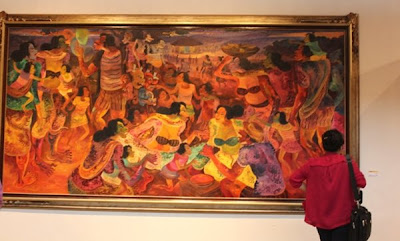
ExamplePaintings by Raden Saleh Sharif Bustaman, Basuki Abdullah, and other painters of the modern era.
ArtistRaden Saleh Sharif Bustaman, Abdullah Sr., Pirngadi, Basuki Abdullah, Wakidi, Wahid Somantri, Agus Jaya Suminta, S. Sujoyono, Ramli, Abdul Salam, Otto Jaya S, Speech, and Emira Sunarsa.
Contemporary art
Contemporary art is a branch of art that affected the impact of modernization. Contemporary that means contemporary, modern or rather is something similar to the conditions at the same time or at this time. So contemporary art is art that is not bound by the rules of a bygone era and evolve with the times now. Contemporary paintings are works thematically reflect the situation while being traversed. For example, the painting is no longer bound to the Rennaissance. Similarly, the dance, more creative and modern.
The characteristics ofNot bound by the rules of a bygone era and evolve with the times.The absence of a gap between the various disciplines of art, aka melting the boundaries between painting, sculpture, graphics, crafts, theater, dance, music, to political action.ExampleThe works of art happenings, works of Christo and various works of art enviromental.
ArtistGregorius Sidharta, Christo, and Saptoadi Nugroho.

Claude Monet painting of lotus Sold Rp 412 Billion

One of the lotus flower painting works of Claude Monet sold for 43.7 million U.S. dollars, or approximately USD 412 billion in an auction in New York.
In addition, paintings by Wassily Kandinsky also sold for 23 million dollars in Impressionisme and Modern art auction Christie's, which is a new record for the artist.
The work of Picasso and Miro are also sold in the first two weeks of the auction.
However, about 30 percent of 69 paintings auctioned failed to find a buyer, reports Reuters news agency.
Oil painting titled "Nympheas" was created in 1905 when Monet lived in Giverny. Initially, it was estimated would sell between 30 million and 50 million U.S. dollars.
Among the numerous works of art that failed to sell was Picasso sculpture, Coq, which is estimated to be worth between $ 10 million-15 million U.S. dollars and a number of works of Chagall and Degas.
Some experts warn disparity between the value of art and the economy can not continue to happen. Although the works are coveted by collectors continue to increase in value, the other sectors of the art market did not get the same interest.
However, Brooke Lampley, division chief Impressionisme and Modern art at Christie's, said the auction was "very strong sales with exceptional results."
On Thursday (11/08/2012), auction house Sotheby's will hold an auction of impressionism. This event was postponed three days because of the storm Sandy.
Among the 68 works on offer, the interest of collectors focused on a painting by Pablo Picasso titled "Still Life with Tulips" the maestro painted cubism within three hours in 1932.
Next week, the auction house will hold two auctions of contemporary art, some of which offer the works of Jean-Michel Basquiat titled "Untitled" from 1981.
Auctions can be a new record for the artist, who died at the young age.
Basquiat initially known as a graffiti artist in New York City before becoming one of the most famous painters in the city.
He died at the age of 27 years due to heroin addiction in 1988.

10 Art Theater Traditional Indonesia

10 Art Theater Traditional Indonesia
1. PuppetPuppet known since prehistoric times ie about 1500 years before Christ. Indonesian society embracing animist beliefs such as ancestor worship of spirits called or dahyang hyang, manifested in the form of statues or images.Wayang is an Indonesian traditional arts are mainly developed in Java and Bali. Puppet show has been recognized by UNESCO on November 7, 2003, as the work of an amazing culture in the field of narrative story and legacy of beautiful and valuable (Masterpiece of Oral and Intangible Heritage of Humanity).G.A.J. Hazeu said that the puppets in the language / Javanese word means: shadows, in the Malay language means: shadows, which means shadow, vague, dreamy. Bikol languages ​​according to the Professor Kern, shadows, goods or dreamy. All of it comes from the root word "that" that changed the sound yung, yong, as in the words: laying (nglayang) = a, dhoyong = yong, reyong = yong, reyong-reyong, or reyang-reyong meaning always on the move while carrying something, Poyang-payingen, intricate origin of the word: Poyang, the root word. According to the comparison of the meaning of the word comes from the root, and so on before, it is clear that the meaning of the root word: a, yung, yong is moving many times, not fixed, floating.
2. MakyongMakyong is the art of traditional Malay community theater, which is still popular and frequently performed as dramatari in international forums. Makyong influenced by Hindu-Buddhist Thai culture and Hindu-Javanese. Makyong name comes from mak hyang, another name for the goddess Sri, the goddess of rice.Makyong is a traditional theater that comes from the island of Bintan, Riau. Makyong derived from art around the palace of the 19th century until the 1930's. Makyong do during the day or night. ± three-hour long performance
3. Drama GongDrama Gong is a form of Balinese performing arts that is still relatively young is created by combining the elements of modern drama (non traditional Balinese) with elements of traditional Balinese arts. In many ways the Drama Gong is a blending of elements of modern theater (West) with traditional theater (Bali). Because of the dominance and influence of classical or traditional Balinese art is still so strong, the Drama Gong originally called "classic drama". Drama Gong name given to this art because of the players and the play every motion accompanied by dramatic mood shift Gamelan Gong (Gong Kebyar). Drama Gong was created around 1966 by Anak Agung Gede Raka Payadnya Abianbase village (Gianyar).Drama Gong began to flourish in Bali around the year 1967 and its peak is tahun1970. However, since the mid 1980's art began to decline in popularity, today there are about 6 pieces sekaa Drama Gong is still active.
4. RandaiRandai is art (theater) typical of the Minangkabau, West Sumatra, which is played by several people (in groups or teams). Randai can be interpreted as "having fun while in a circle" because the players stood in a large circle diameters are five to eight feet in length. Stories in randai, always lift Minangkabau folktales, such as Mato Cindua story, Malin Deman, Anggun Nan Tongga, and other folklore. The legend says that randai first played by the Pariangan, Padang Panjang, when they managed menangkaprusa coming out of the sea.Art randai been staged at several places in Indonesia and even the world. Randai Even the English version had been staged by a group of students at the University of Hawaii, USA.Art randai rich with ethical and aesthetic value of traditional Minangkabau, is a result of the merger of several kinds of arts, such as drama (theater), art, music, dance and martial arts.
5. MamandaMamanda is the traditional art of theater or performance which originated from South Kalimantan. Compared with the art of staging another, more akin Mamanda Lenong terms of the relationship between the player with the audience. This interaction makes the audience becomes active convey humorous comments which allegedly can create the atmosphere became more lively.The difference is, now more to follow Art lenong Mamanda than a monotonous day at the royal storyline. Because the art Mamanda playable characters are raw figures like King, Prime Minister, Mangkubumi, Wazir, War Commander, First Hope, Hope second wage earner (Clown / aide), Empress and Sandut (Princess).Mamanda allegedly used the term because in lakonnya, players like Wazir, Minister, and was called pamanda Mangkubumi or mamanda by the King. Mamanda etymologically composed of the word "mama" (mamarina) which means uncle in Banjar language and "ou" meaning honorable. So mamanda means Dear uncle. Ie "hello" to a respected uncle or family in the kinship system.The origin is Mamanda Badamuluk art troupe brought Abdoel Moeloek of Malacca in 1897. Formerly in South Kalimantan Comedy Indra named Duke. Engagement with the local arts in Banjar royal Indra Comedy spawned a new art form called Ba Abdoel Moeloek or more fame with Badamuluk. This art until now better known as mamanda.Starting from the arrival of royalty Malacca (1897 AD), led by Encik Ibrahim and his wife, Cik Eve in the Land of Banjar, art was popularized and was warmly welcomed by the people of Banjar. Once adapted, the theater gave birth to a new theater named "Mamanda".Mamanda traditional performing arts are very popular among the people of Kalimantan in general
6. LongserLongser is one form of traditional theater community Sunda, West Java. Longser acronym derived from the word Melong (seen with admiration) and saredet (temperamental) which means that anyone who saw the show longser, then his heart will be stirred. Longser an emphasis on dance called ogel or doger. Before longser born and developed, there is a traditional theater form called Lengger.Clothing used for this art is simple but striking color, especially in terms of clothing worn by the dancer. Usually a dancer wearing kebaya and batik cloth side. Meanwhile, for a man to wear the pants sontog shucks and headband.
7. KetoprakKetoprak is the most popular folk theater, especially in the areas of Yogyakarta and Central Java. However, in East Java can be found ketoprak. In these areas ketoprak is a blend of folk art in their lives and beat the other folk arts such as srandul and emprak.The word 'kethoprak' comes from the name of the tool that is Tiprak. The word originated from the practice of this Tiprak. Because sound is tiprak crunch, crunch, crunch. King Library Purwa fiber volume II writing poet R. Ng. Rangga Warsita Kolfbunning in 1923 in his book states "... tetabuhan ingkang kethoprak name tegesipun kothekan"This means kethoprak crunch sound comes from, although originally stems from a tool called tiprak.Kethoprak also from kothekan or gejogan. Musical instrument in the form of mortar by the creator kethoprak plus drums and flutes.Ketoprak is one form of folk theater are very concerned about the language used. Language is getting attention, despite the use of Java language, but should be considered a problem unggahungguh language. In the Javanese language levels are used, namely:- Java Language regular (daily)- Java Language kromo (for higher)- Java Language kromo inggil (ie for the highest level)Using language in ketoprak, which considered not only the use of the levels of language, but also the subtleties of language. Hence the so-called ketoprak language, Java language with the language of the subtle and specific.It can be concluded that Kethoprak is performing arts theater or a simple drama that includes elements of Javanese tradition, both the structure of the play, dialogue, fashion makeup, as well as the sounds of traditional music was performed by the people.
8. LudrukLudruk is one Timuran Javanese art is very well known, the art of the stage which is generally all players are men. Ludruk is a traditional drama that was exhibited by an arts group in gelarkan disebuah stage to take the story of the lives of everyday people (grassroots story), a story of struggle and others are interspersed with jokes and accompanied by gamelan as a musical.Dialogue / monologue in ludruk are entertaining and make the audience laugh, Surabaya natural language, although sometimes there are guest stars from other areas such as Jombang, Malang, Madura, Madiun with a different accent. Straightforward language used on ludruk, making him easily absorbed by the non-intellect (pedicab drivers, watchmen, public transport drivers, etc.).
9. Lenong"Lenong" is a traditional performing arts theater Betawi people, Jakarta. Lenong derived from the name of a Chinese merchant named Lien Ong. That said, the first Lien Ong who used to call and hold a theater that is now called Lenong to entertain the public and especially himself and his family. In olden times (colonial era), lenong usually played by the public as a form of appreciation opposition to the tyranny of the invaders.Theatrical arts may be an adaptation by the Betawi arts community alike as "vaudeville" and "theater opera" existing at the time. In addition, Word Muntaco, Betawi artist, says that lenong evolved from the xylophone music teaterisasi kromong and as a spectacle has been known since the 1920's.At first this art performed by singing from village to village. Performances are held in the open air without a stage. As the show progresses, one actor or actress around the audience while asking for voluntary donationsThere are two types lenong lenong lenong Denes and thugs. In lenong Denes (from Denes said the Betawi dialect meaning "office" or "official"), actors and actresses wore formal clothes and air-setting tale kingdom or the nobility, while in civilian clothing worn lenong not determined by the director and generally revolves around everyday life. In addition, both types of lenong is also distinguished from the language used; lenong Denes generally use refined language (Malay high), while lenong thugs using colloquial language.
10. Ubrug"Ubrug" in the park is known as a traditional folk art that is increasingly forgotten by fans. The term 'Ubrug' comes from Sundanese 'sagebrugan' meaning jumbled in one location.Ubrug including folk theater art that combines elements of theater, music, dance, and martial arts. All the elements were staged as a comedy. The language used in the play, sometimes merging of Sundanese, Javanese, and Malays (Betawi). Musical instrument is usually played in pemenetasan drum, kulanter, kempul, gong angkeb, fiddle, kenong, manacle, and tap.In addition to growing in the province of Banten, art Ubrug was expanded to Lampung and South Sumatra which would be staged using local languages ​​respectively.Ubrug theater was originally staged in a wide courtyard with palm leaf tents or rubia.Blancong used for lighting lamps, kerosene lamps are two wheelbase and large enough placed in the middle of the arena. Blancong lamp is the same as the tap Tilu Oncor, with lights or lamps gembrong petromak. Around the year 1955, Ubrug began using the stage or room, either a closed or open where the audience can see it from all directions.

Arts streams, figures, and Examples of Work

 
Studying art is basically studying human civilization.


The history of civilization can not be separated, because basically

among the nation's art of giving and receiving influences. but for
makes it easy to learn should be held grouping.


Chronologically foreign art history / world can be grouped as follows.
Ancient Eastern Arts 1.Seni
a.Seni Egypt.
b.Seni Mesopotamia.
c.Seni Mediterranean.
2.Seni Classical European Art.
a.Seni Greece
b.Seni Roman.
3.Seni Middle Ages.
The a.Seni Pembenyukan
b.Seni Gemilang period.
c.Seni period of decline.
4.Seni Renaissance
a.Seni Renaissance.
b.Seni Baroque.
c.Seni Rococo.
Modern 5.Seni.

Scientists say that the modern Western art is basically derived from Greek and Roman times
called the Classical era. Greek culture was brought to Western Europe via Rome.
The development of science and technology at the beginning of the 19th century led to the emergence of various
product. This situation finally changed many aspects of human life, not least in the field of fine arts.
Attention humans tend to things that are material, this leads to rebellion
artists. Rebellion artists manifested in the forms of creativity, so in the world
development of art born in the schools of art menerusakan each other or against the flow-
previous flow.

DANCE ARTS

The art of dance is an expression of the soul that contains elements of beauty in the form of an organized movement to the rhythm of the accompaniment. Dance is the beauty of motion limbs moving, rhythmic and harmonious spirit.
There are three main elements in the dance, which wiraga (physical), wirama (the music), and wirasa (inspiration or expression). Dance and movement used to have differences in terms of smoothness, dynamics (rhythm and tempo), and accompaniment.

 
  TYPE OF DANCE

    
Types of Traditional Dance
Traditional dance is a dance that developed in certain areas which is based on the adaptation and extensive guided hereditary habit and embraced by the public owner of the dance. Traditional dance is divided into two kinds, namely:

    
Traditional dance classics
The characteristics of traditional classical dance is as follows.

    
The patterns of movement have been determined.

    
It has a high artistic value

    
Motion mnimal created exceed the needs required by the context.

    
Grow and develop from the nobility.

    
Measures of beauty beyond the borders of the region.
Examples of traditional classical dance is dance Bedaya Ketawang of Central Java.

    
Folkasik traditional dance (folk dance)
Characteristics tradisiomal folkasik dance (folk dance) is as follows.

    
The patterns of motion is determined by the context, folk dances usually have a specific theme.

    
Social and artistic value is.

    
Treasury limited motion just enough to accent the custom events typical of the tribes concerned.

    
Comes from the people, by the people and for the people.

    
Limited to certain customary territory.
Examples of this dance is the dance Tayub of Central Java.

    
Type of Creative Dance
Dance is a dance creations that have characteristics that are no longer following motion patterns and ingredients are settled. Dance creations comes from traditional dance that has dkembangkan. For example, Oleg Tambulilingan Dance and Dance of Bali and Sumatra fan of. Creative dance is divided into two kinds, namely:

    
Modern dance
The characteristics of modern dance is as follows.

    
Patterns freer movement but still pay attention to beauty.

    
The motion is still used to give emphasis to the movement that grew out of the traditional dance.

    
Still remain within the framework of a tribal dance traditions.
Examples of modern dance is a dance of Merak in West Java.

    
Contemporary dance
The characteristics of contemporary dance is as follows.

    
Patterns of freer movement of modern dance.

    
The motion used is no longer based on the traditional dance.

    
Tata dance created in the moment.
Examples of contemporary dance is a dance created by Boy G. Sakti, Tom, Ibnur, Sardono W. Kusuma.
In addition to the above two types of dance, dance can also be differentiated based on function and form of presentation.

    
Types of dance by function

    
Dance ceremony
In public life in the archipelago, the ceremony has been held long ago. Usually in the ceremony, used as the medium of dance. Ceremonies often use dance as a medium, namely:

    
Religious ceremonies, such as Sang Hyang Tari, Gabor, Puppet Uwong and Gambuh (Bali), Ngalase (West Java), Sanyang (East Java), and Seblang (Banyuwangi).

    
Ceremony greatness keistanaan (Kraton), such as Dance Bedoyo Semang (Yogyakarta), Srimpi (East Java), and Gending Sriwijaya (Palembang).

    
The ceremony is important in human life, such as the harvest was celebrated with a ceremony Pakarena (South Sulawesi), circumcision ceremony is celebrated with dance sisingaan (Subang), the marriage ceremony was celebrated with dance Lawung (Yogyakarta).

    
Social dance or entertainment
Several types of dance entertainment that tube of Balinese Dance, Dance Ronggeng and Rantak Kudo of Sumatra.

    
Dance performances
Dance performances deliberately cultivated for reassembly and require a steady cultivation. However, there are also dance performances initially serves as a ceremonial dance or entertainment, then turned into a dance show. Here are some examples of dance performances: Pendet of Bali, Tayuban Dance from West Java, and East Java Dance Ngremo.

    
Types of dance based forms of presentation
Based on the form of presentation, dance divided, emjadi four types, namely single dance, dance in pairs, mass dance, drama and dance.

    
Solo Dance
Solo dance is a type of dance performed by a dancer. Examples of single dance the dance Ghatotkacha, Klana Mask Dance, and Dance Panji.

    
Dance in pairs
Dance in pairs is a type of dance that is played by two dancers that are complementary to one another. Two female dancers all or it could be all-male, the other female bias one man. This type of dance was composed of several couples. Examples of dance performed by a pair of dancers, the dance Damarwulan, Rara Mendut Dance and War Dance Sugriwo-Vali.

    
Mass Dance
Mass dance is a dance performed by more than one dancer without complementary elements. Some examples of the mass dance, the dance Gambyong of Surakarta, Yogyakarta Dance of the Marionette, and Dance Mafia of Irian Jaya.

    
Dance Drama
Dance drama performed by several dancers. Dance drama presented in story form, divided into rounds or scenes. Beberpa example of the Wayang Wong dance drama of Central Java, Puppet Mask from Cirebon, and Randai and Makyong of Sumatra.

    
DANCE COMPOSITION

    
Form (pose)
Form (pose) is the position of the body before moving. Divided into four, namely open, closed, asymmetric and symmetric.

    
Movement
The motion is to move the position of the body shape.

    
Floor pattern
Floor pattern is the direction or line of action through which the dancers. The pattern is divided into two floors, straight and curved.

    
Direction toward
Direction toward the direction the position of the dancer's body.

    
Level or level
Level or levels are the levels of the dancer's body position. Divided into three, bottom, middle, and top.

    
Expression or inspiration

    
ROLE OF DANCE
As an activity, dance has several functions as follows.

    
Dance as a means of unifying the nation
For example, the area of ​​national dance festival performances, and festivals isen Mulang.

    
Dance as a medium of expression
Dance can create a series of movements that can make the audience sensitive to something that exists and is happening around him.

    
Dance as a means of ceremony
Types of dance is a lot of stuff as described in the previous section.

    
Channeling of dance as therapy
Types of dance is usually addressed to persons with physical or mental disabilities. In the east, the type of dance has become taboo because of taste not the heart.

    
Dance as a medium of communication
Dance performances convey messages that are in his every movement. Examples are Pakarena of South Sulawesi used to congratulate dating to the guests.

    
Dance as a medium for creative thought
Covers seven aspects of human intelligence, that is the logic, language, visual, kinestik, musical, intrapersonal, and interpersonal. The seven aspects that need attention are balanced in education so that students will be more creative thinking. Dance, one sa arts education in schools, to develop skills in aspects kinestik. Dance can be a tool for creative thinking bias.

    
Dance as a medium to develop talent
In schools held arts education, which is one aspect of the art of dance. Dance education can be used as a tool for developing talent.

    
Dance as entertainment
Dance as entertainment should be varied so as not to dull and boring. Therefore, this type uses the themes are simple, no heroics, a good tune and exciting. Costumes and stage layout prepared in interesting ways.

    
Dance as a medium of interaction
The art of dance is a collective, meaning the cultivation of dance involving several people. Therefore, kegiata dance can serve as a means of interaction. Dance activities, such as dance workout routine or staging together, is a good means of association.